|
Oily Sludge Pit Remediation – Risk Assessment Study The main objective of this study was to conduct a health
risk assessment of on- and off-site receptors as a result of exposure to
chemicals from the oily sludge pits that have been in the Al-Khafji joint
operational area for the last 40 years.
A local company conducted a field survey, collected soil
and groundwater samples from several locations, and performed geotechnical and
hydrogeological investigations of the site. Samples were collected from several
locations in the study area to determine the concentration of metals, total
petroleum hydrocarbons (TPH), volatile organic compounds (VOC’s), benzene
toluene, ethylbenzene, xylenes (BTEX), and polycyclic aromatic hydrocarbons
(PAHs) in the soil and groundwater. The identification of the constituents of
concern (COCs) in the study area was based on the analytical results obtained
from soil, groundwater and TCLP tests. Information on the persistence of the
chemicals in the environment, toxicity and decay coefficients, and their
bioaccumulation characteristics was also used for the study and are stored in
the chemical database in Integrated Saudi Aramco Risk-based Corrective Action
(ISARBCA) software. For selected COCs, concentration
estimates were made at several locations in the study area. Analytical
models such as the Domenico groundwater model, Gaussian air dispersion model,
indoor and outdoor air quality models of Johnson & Ettinger and several
other models for Tier 2 evaluation within American Society of Testing Materials
Risk-based Corrective Action (ASTM RBCA) software were used to study the fate
and transport of the COCs in soil, air, and groundwater. A tiered approach was then applied to determine the risk to
the construction workers, the contamination to groundwater, and the risk due to
air-borne chemicals to receptors in open air and enclosed spaces, such as
office buildings and storage areas.
The only contaminants of
concern for the risk assessment study were PAH constituents in soil and groundwater,
TPH fractions, and polychlorinated biphenyls (PCBs). Within PAHs, the individual carcinogenic PAH constituents of
primary interest include: benzo(a)anthracene, benzo(a)pyrene (B(a)P),
benzo(b)fluoranthene, benzo(k)fluoranthene, chrysene, dibenz(a,h)anthracene,
indeno(1,2,3-cd)pyrene. Other PAHs of interest as non-carcinogens for risk
assessment studies were: naphthalene, acenaphthylene, enaphthene, thracene,
fluorene, phenanthrene, fluoranthene, pyrene, and benzo(g,h,i)perylene. Other
important constituents for hydrocarbon site assessment are BTEX. Metals were
also not detected in most of the samples. In a few samples, however, barium was
detected, but its concentration was much lower than the regulatory limit.
Similarly, VOCs were also below the detection limit in all samples. The samples
were also analyzed to determine PCBs in soil and groundwater. No PCBs were
found in the groundwater. However, out of 78 soil samples taken from various
locations, only two showed PCBs. The health risk assessment
was carried out at the points of measurement, in addition to off-site locations
in the study area using maximum concentration of primary individual in PAH and
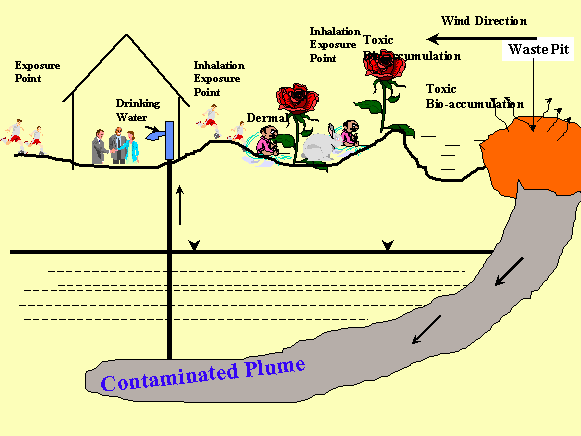
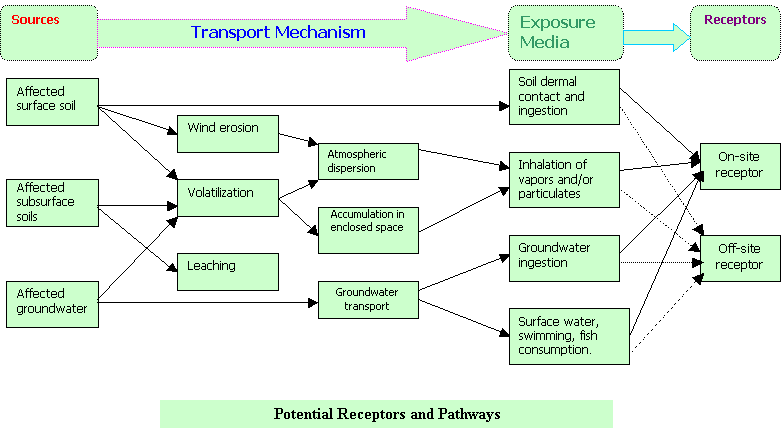
PCB constituents. The potential pathways identified were affected groundwater,
the leaching of soil into groundwater, and the volatilization of COCs from soil
and groundwater into the ambient air and indoor spaces. The receptors
considered were construction workers, people working in enclosed spaces, and
contaminated groundwater use at off-site locations. Using both Tier 1 and
Tier 2 approaches, concentration estimates were made in the soil, groundwater,
and air at on- and off-site receptor locations. In the case of the Tier 1
approach, risk-based screening levels (RBSLs) at the source or points of
measurement were calculated. While in the case of Tier 2 analysis, the fate and
transport of COCs in the multi-media environment were studied using analytical
groundwater models as well as soil and air dispersion models. For these models,
data on the dispersion coefficients, porosity, soil moisture content, average
rainfall in the study area, soil type, capillary zones, soil/water pH values,
and other soil and hydrological parameters were required. The local company
supplied data on these parameters by conducting geotechnical and hydrological
investigations in the study area. Measured concentrations
and estimates based on modeling were used to determine the average daily intake
values of COCs through all possible pathways considering exposure duration, body
weight of the receptors, and exposure frequency. Since no such database has been established yet for Saudi Arabia,
default ISARBCA values were used. The estimated intake values were later used
as input to estimate the individual lifetime carcinogenic risk and toxic
effects to the receptors. Since in this study, the risk levels as predicted by Tiers 1 and 2
models are much lower than the target levels, there was no need to undertake a
Tier 3 study, although ISARBCA has Tier 3 options. Tier 3 analysis requires a
large amount of data on soil and groundwater characterization, hydrogeological
data of the study area, land-use plan, and precise locations of the receptors
and their types. For
further information, please contact: EnviroRisk International, Inc. 36 Pearson Street St.
John’s, NL A1A 3R1 Canada Tel.
(709) 237 0376 Fax (709)
237 0376 E-mail: admin@envirorisk-int.com |